

AI Agents
AI Agents vs Traditional Automation: Which Is Better?
Zhorx · September 9, 2026 · 8 min read
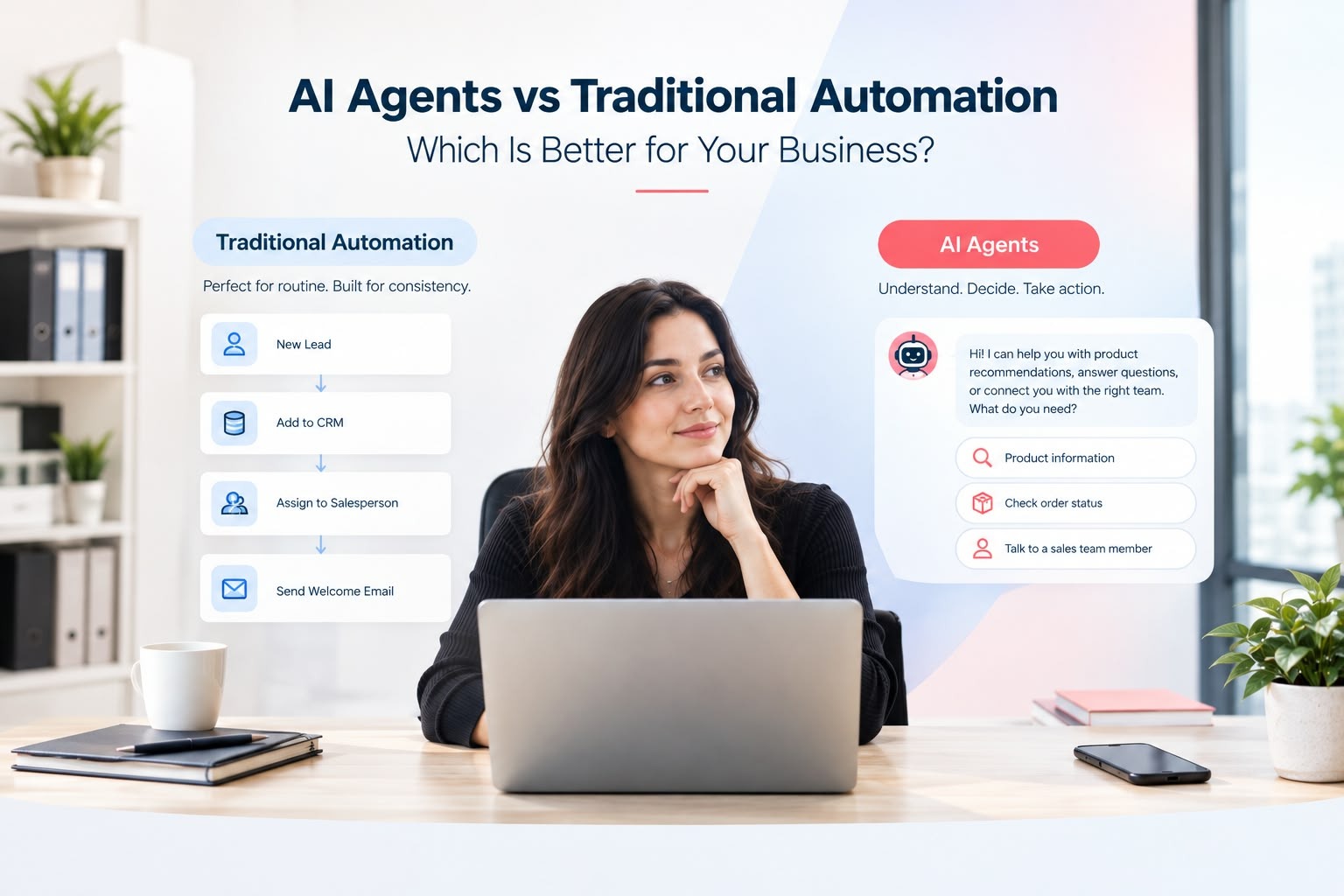
Businesses are investing more in automation to reduce manual work, improve efficiency, and create better customer experiences. But not every business process needs the same type of automation. Some tasks follow clear rules and repeat the same way every time. Others require understanding information, making decisions, and responding differently depending on the situation. This is where the difference between AI agents and traditional automation becomes important. Both approaches can deliver strong business value, but they solve different problems. Understanding where each one works best can help businesses avoid unnecessary complexity and choose an automation strategy that actually supports their goals.
A free automation audit can help identify which processes are better suited for traditional automation, AI agents, or a combination of both.
What Is Traditional Automation?
Traditional automation uses predefined rules to complete specific tasks. The business defines what should happen when a particular condition occurs, and the system follows those instructions consistently. For example, when a customer submits a form, an automation can create a CRM record, assign the lead to a salesperson, send a confirmation email, and update the lead status. Each action happens because it was specifically defined in the workflow. This makes traditional automation highly effective for repetitive and predictable processes. When the same situation should produce the same result, a rule based workflow can often handle the task without needing advanced AI.
What Is an AI Agent?
An AI agent is designed to handle tasks that require interpretation, decision making, and flexible responses. Instead of following only a fixed sequence, it can evaluate information and determine what action makes sense based on the situation. For example, an AI agent can receive a customer enquiry, understand what the customer needs, determine the type of request, and decide whether it should respond directly or involve a member of the team. The main advantage is flexibility. Traditional automation generally follows predefined instructions, while an AI agent can work through situations where the exact path was not defined in advance.
AI Agents vs Traditional Automation: What Is the Difference?
The biggest difference is how each system handles decisions. Traditional automation works best when the business already knows the conditions and actions. If a lead meets a certain condition, assign it to a particular salesperson. If an invoice is approved, move it to the next stage. If a customer books an appointment, send a confirmation. AI agents are more useful when information needs to be understood before the next action can be selected. This could involve reading an email, understanding a customer conversation, analyzing a document, or determining the intent behind a request. Neither approach is automatically better. The right choice depends on how predictable the process is and how much decision making the task requires.
When Is Traditional Automation Better?
Traditional automation is usually the better option for simple processes with clear rules. It provides a straightforward way to automate repetitive work without introducing unnecessary complexity. Common examples include CRM updates, lead assignment, notifications, scheduled reports, data transfers, invoice routing, and standard follow up sequences. Traditional automation can also be preferable when consistency is more important than flexibility. If the business wants the same action to happen every time a particular condition is met, a fixed workflow can provide strong control and predictable results.
When Are AI Agents Better?
AI agents become more valuable when employees need to understand information before taking action. This is particularly useful when the information is unstructured or when there are many possible situations. Customer enquiries are a good example. A traditional workflow can route an enquiry based on predefined form fields. An AI agent can examine the actual message and determine what the customer is asking about, even when the customer does not use the exact terminology defined in the system. AI agents can also help when employees spend significant time researching information, qualifying leads, reviewing documents, or deciding what should happen next.
Which One Handles Complex Business Processes Better?
Complexity does not automatically mean that a business needs an AI agent. If a process contains many steps but every step follows a fixed rule, traditional automation can still manage it effectively. The number of steps is not the deciding factor. The type of decision involved is more important. If the complexity comes from different types of information, changing circumstances, or decisions that depend on context, an AI agent can provide more flexibility. For example, processing an invoice according to fixed approval rules can be handled through traditional automation. Understanding an unusual invoice, identifying missing information, and determining whether someone should review it may benefit from AI.
Can AI Agents and Traditional Automation Work Together?
Yes. In many businesses, combining both approaches can create a more effective system than using either one alone. An AI agent can handle the part of the process that requires interpretation, while traditional automation can manage predictable actions that follow. For example, an AI agent could read a new customer enquiry and determine the prospect’s intent and potential qualification. Traditional automation could then update the CRM, assign the lead, notify the salesperson, and start the appropriate follow up process. This creates a practical division of responsibilities. AI handles flexible decision making, while traditional automation handles structured execution.
What Are the Risks of Using AI Agents?
AI agents provide flexibility, but that flexibility also requires appropriate controls. An AI system may interpret information differently depending on the context, so businesses should carefully define what the agent can and cannot do. This is especially important when an AI agent can take actions involving customers, financial information, sensitive data, or important business decisions. Businesses should determine which actions an AI agent can perform independently and which actions should require human approval. A controlled approach allows companies to benefit from AI while maintaining appropriate oversight.
Practical Business Example: AI Agents vs Traditional Automation
Consider a company that receives hundreds of enquiries through its website. Before automation, an employee manually reviews each enquiry, decides whether the lead is relevant, assigns it to a salesperson, and sends an initial response. With traditional automation, the company could automatically capture the lead, create the CRM record, assign it according to predefined criteria, and send a standard response. This removes repetitive work while keeping the process predictable. With an AI agent, the system could read the actual enquiry, understand what the prospect wants, identify potential buying intent, and recommend the appropriate sales route. Traditional automation could then complete the CRM updates, notifications, and other predefined actions. In this situation, the best solution may not be AI alone. Combining AI decision making with traditional automation can create a workflow where each technology handles the part of the process it is best suited to manage.
How Should You Choose the Right Approach?
The decision should begin with the business process rather than the technology. Ask whether the task follows clear rules or whether employees need to interpret information and make decisions. You should also consider the consequences of an incorrect decision. A simple lead routing decision may allow more flexibility, while financial transactions or sensitive customer actions may require stricter controls. Cost and maintenance should also be considered. A simple traditional workflow may be more practical for a straightforward task, while an AI agent may provide significantly more value when employees spend substantial time handling complex information. Businesses exploring different automation approaches can also review automation projects to understand how different processes can be matched with the right automation strategy.
What Should Your Business Automate With Traditional Automation?
Traditional automation is a strong fit for tasks where the rules are already clear and the expected outcome is predictable. This can include CRM updates, lead routing, notifications, data synchronization, scheduled tasks, standard follow ups, internal alerts, and repetitive administrative work. If you can clearly describe the process using conditions and actions, traditional automation may already be enough to remove a significant amount of manual work.
What Should Your Business Automate With AI Agents?
AI agents are better suited to tasks where understanding and decision making are important parts of the work. Examples include lead qualification, customer enquiry handling, document analysis, research, sales assistance, appointment conversations, and other processes where information needs to be interpreted before an action is selected. The objective should not be to use AI simply because it is available. AI should be introduced when its ability to understand information and make context based decisions creates meaningful value for the business.
Key Takeaways
- Traditional automation works best for predictable, rule based processes.
- AI agents are useful for tasks involving interpretation and decision making.
- Traditional automation provides strong consistency and control.
- AI agents provide greater flexibility when situations vary.
- Businesses can combine AI agents with traditional automation.
- The right choice depends on the process, risk, complexity, and desired outcome.
- AI should solve a genuine business problem rather than add unnecessary complexity.
Final Thoughts
AI agents and traditional automation are not technologies where one must always replace the other. They are different approaches designed for different types of business problems. Traditional automation remains highly effective for repetitive processes with clear rules. AI agents become valuable when a workflow requires understanding, context, and flexible decision making. For many businesses, the strongest strategy will be to use both. Let AI handle the parts that require interpretation while traditional automation manages the predictable actions that need to happen consistently. The goal is not to use the most advanced technology. The goal is to build an automation system that solves the business problem efficiently, reliably, and at the right level of complexity.
FAQs
What is the difference between AI agents and traditional automation?
Traditional automation follows predefined rules and instructions, while AI agents can interpret information, make decisions, and respond based on context.
Are AI agents better than traditional automation?
Not always. Traditional automation is often better for simple and predictable processes, while AI agents are more useful when tasks require interpretation and flexible decision making.
Can AI agents and traditional automation work together?
Yes. AI agents can handle interpretation and decision making, while traditional automation can manage predictable actions such as CRM updates, notifications, and follow ups.
Which business processes are best for AI agents?
AI agents can be useful for lead qualification, customer enquiries, document analysis, research, sales assistance, and other tasks that require information to be understood before an action is taken.
Which business processes are best for traditional automation?
Traditional automation works well for CRM updates, lead routing, notifications, data synchronization, scheduled tasks, standard follow ups, and other repetitive processes with clear rules.
Want a second opinion on your list?
Send it over. We’ll tell you where we’d start, and what we’d leave alone.