

AI Automation
Who Monitors AI Automations After They Are Deployed?
Zhorx · September 5, 2026 · 8 min read
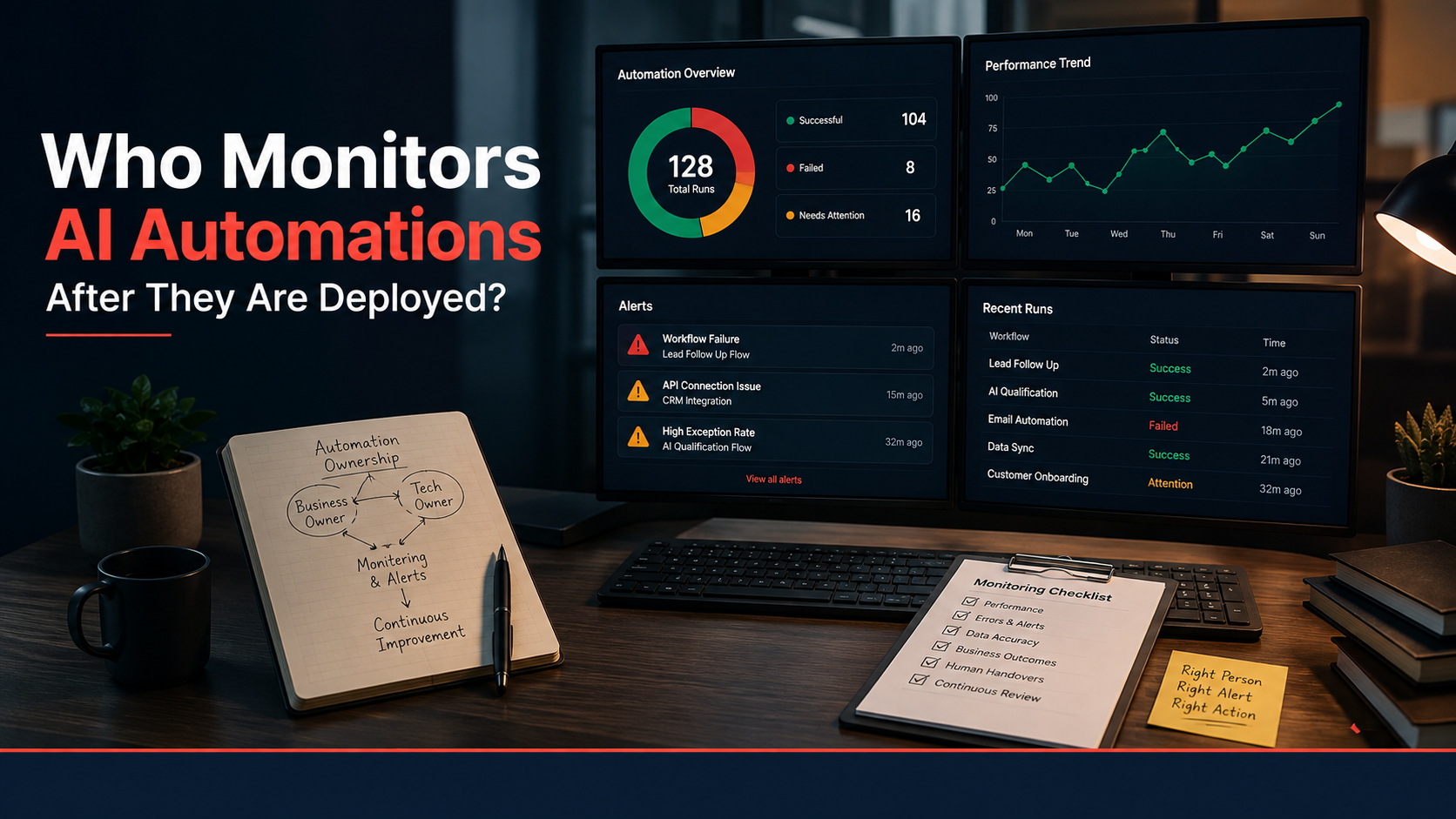
Launching an AI automation is only one part of making it useful for a business. Once the workflow is running, someone still needs to know whether it is producing the expected results, whether the business process has changed, and whether a problem needs attention.
This is where many businesses create an ownership gap. The sales team assumes the technical team is monitoring the system. The technical team assumes the business team will report problems. An external automation partner may assume everything is fine because nobody has reported an issue.
The result is simple: an automation can continue running while nobody is actively responsible for making sure it is working properly.
If your business already uses several automated workflows or is planning to deploy new ones, a free automation audit can help identify where ownership, visibility, and responsibility are unclear.
Why Ownership Matters After Deployment
AI automation affects real business processes, so monitoring should not be treated as a purely technical responsibility. A workflow may execute successfully from a system perspective while still producing results that are not useful for the business.
For example, an AI lead follow up workflow may send messages successfully, but the sales team may notice that the messages are no longer appropriate for certain types of leads. The automation is technically running, but the business outcome has changed. Someone needs to recognize that difference and decide what should happen next.
Clear ownership prevents this uncertainty. When everyone knows who watches performance, who investigates technical issues, who approves business changes, and who handles urgent problems, an automation becomes much easier to manage over time.
What an Automation Owner Is Actually Responsible For
An automation owner is the person or team responsible for making sure the workflow continues to support its intended business purpose. This does not necessarily mean that they personally fix every technical problem.
Their responsibility is more about accountability. They should know what the automation is supposed to accomplish, understand the important results it produces, and know who should be contacted when something goes wrong.
A strong owner should also be aware of business changes that could affect the workflow. If the sales process changes, a CRM field is renamed, a new qualification rule is introduced, or the company changes how leads are handled, the owner should make sure the automation is reviewed rather than assuming it will adapt automatically.
The Business Owner and Technical Owner Have Different Jobs
One of the biggest mistakes businesses make is expecting one person to understand every part of an automation. Business ownership and technical ownership are usually different responsibilities.
The business owner understands why the automation exists and what success looks like. They can identify whether leads are being handled correctly, whether customers are receiving appropriate communication, and whether the workflow still fits the company’s current process.
The technical owner understands how the automation is connected. They can investigate workflow failures, integration problems, authentication issues, data mapping problems, and other technical conditions that affect execution.
These roles can belong to the same person in a small company, but the responsibilities should still be clearly separated. Knowing who owns the business result and who owns the technical system makes escalation much easier.
What the Technical Team Should Watch
The technical side of monitoring focuses on whether the automation is operating correctly. This includes checking whether workflows are executing, whether connected systems are responding, and whether unexpected errors are appearing.
Technical monitoring can also reveal patterns that are difficult to notice from the business side. A workflow may suddenly experience more failed runs than usual, an integration may start returning unexpected information, or data may stop moving correctly between systems.
The technical owner does not need to manually inspect every automation every day. The goal is to have enough visibility to recognize important changes and investigate them before they create larger business problems.
What the Business Team Should Watch
Business teams should focus on outcomes rather than technical details. They need to know whether the automation is helping the process it was designed to improve.
For a lead management workflow, this could mean watching whether leads are being contacted appropriately, whether qualified leads are reaching the sales team, and whether follow up activity is contributing to better sales performance.
For customer service automation, the focus could be whether customers are receiving useful responses, whether conversations are reaching the right people when necessary, and whether the automated experience matches the company’s service standards.
This distinction is important because technical success does not always equal business success. A workflow can have no system errors and still fail to deliver the result the company needs.
When an External Automation Partner Should Be Involved
Some businesses have an internal technical team, while others rely on an automation agency or specialist. In both cases, responsibilities should be agreed upon before the automation goes live.
An external partner may be responsible for technical maintenance, workflow changes, integration support, or more complex troubleshooting. The internal business team may remain responsible for identifying changes in business requirements and approving modifications.
This arrangement works well when communication is clear. The business should know what the external partner monitors, what types of issues they handle, how problems are escalated, and which situations require approval before changes are made.
For companies managing multiple workflows, reviewing previous automation projects can also help clarify the kinds of systems that may require ongoing technical and business ownership.
How Alerts Decide Who Needs to Act
Alerts are only useful when they reach someone who can do something about the problem. Sending every notification to everyone usually creates noise, while sending important alerts to nobody creates risk.
A better ownership model connects different types of problems with the appropriate person. A technical failure may need to reach the technical owner, while a change in lead quality may need the sales manager. A change in business rules may require approval from an operations or business owner.
The important point is that an alert should have an expected response. Someone should know what the alert means, whether it requires immediate action, and when it should be escalated to another person.
What Happens When No One Is Clearly Responsible?
When ownership is unclear, problems often remain unnoticed until they become expensive. Small issues can accumulate because everyone assumes another person is responsible for checking them.
A sales manager may notice fewer leads reaching the team but may not realize that an automation has stopped handling a specific type of lead. A technical team may see that the workflow is executing normally and therefore have no reason to investigate the business result.
This creates a dangerous gap between system activity and business performance. The automation may appear healthy in technical reports while the actual process is becoming less effective.
Clear responsibility closes that gap. Someone needs to own the business outcome, someone needs to understand the technical operation, and everyone involved should know when responsibility moves from one person to another.
Practical Example: An AI Lead Follow Up Workflow
Consider a company that receives new leads through its website. Before automation, a sales manager manually checks incoming leads, assigns them to representatives, and follows up when someone is available. If the manager is busy, some leads may wait longer than expected.
After introducing AI lead follow up, new leads are automatically processed and the sales team receives the relevant information. The workflow handles the repetitive part of the process, but the company still needs clear ownership.
The sales manager can own the business outcome by reviewing lead quality and follow up performance. A technical owner can be responsible for investigating workflow failures and integration issues. If an external automation partner manages the system, that partner can handle technical changes that fall within the agreed support responsibility.
This structure means the automation is not simply left running. Each person has a defined responsibility, and a problem has a clear destination when it appears.
How to Create a Clear Ownership Model Before Deployment
Ownership should be decided while the automation is being designed, not after something goes wrong. Every important workflow should have a clearly identified business owner and technical owner, even if both roles belong to the same person.
The team should also define what each person is expected to monitor. Business owners need visibility into outcomes, while technical owners need visibility into system behavior. External partners should have clearly defined responsibilities if they are involved in maintenance or support.
Documentation also matters because people change roles. A process that depends on one employee remembering how everything works becomes difficult to manage when that employee leaves or moves to another position. Clear ownership records make the automation easier for the next person to understand and manage.
Key Takeaways
- Every deployed AI automation should have clear ownership.
- Business owners should focus on whether the automation achieves its intended result.
- Technical owners should focus on system operation and technical problems.
- External automation partners should have clearly defined responsibilities.
- Alerts should reach the person who can actually respond to the issue.
- Ownership should be established before deployment rather than after a failure.
- Technical success does not always mean business success.
Final Thoughts
AI automation does not become self managing simply because it has been deployed. The system still exists inside a changing business, with changing customers, processes, tools, and priorities.
The strongest automation setups make responsibility clear from the beginning. Everyone involved understands what they own, what they need to monitor, and when they need to involve someone else.
That is what turns automation from a workflow that simply runs into a business system that people can confidently rely on.
FAQs
Who should monitor an AI automation after deployment?
The responsibility should normally be shared between a business owner and a technical owner. The business owner watches outcomes, while the technical owner handles system related issues.
Does the person who built the automation need to monitor it forever?
Not necessarily. The person or company that built the automation may provide ongoing support, but the business should still have an internal owner who understands the purpose and expected outcome of the workflow.
What should a business owner monitor?
A business owner should monitor business results such as lead handling, response quality, sales activity, customer experience, and whether the automation still matches the current business process.
What should a technical owner monitor?
A technical owner should monitor workflow execution, integrations, data movement, failures, unexpected behavior, and technical changes that could affect the automation.
What happens if nobody owns an AI automation?
Problems can remain unnoticed because each team assumes someone else is responsible. Over time, the automation may continue operating while becoming less useful or less aligned with the business.
Want a second opinion on your list?
Send it over. We’ll tell you where we’d start, and what we’d leave alone.